Reading age 16+ · Written in disclosed collaboration with AI systems
The Visual World of the Books
Paintings and studies for all five books (1,366 pages): black-patinated bronze spines inlaid with one continuous beaten-gold running-spiral sea-wave across spine ratios 0.2211 / 0.1859 / 0.1742 / 0.1859 / 0.2328 (78.1 mm), painted covers for Books I to V, character portraits, carved seal chapter openers on white ground, and pure-vector Bronze Age scripts.
Continuous 5-Volume Spine Mural — The Horned Sea
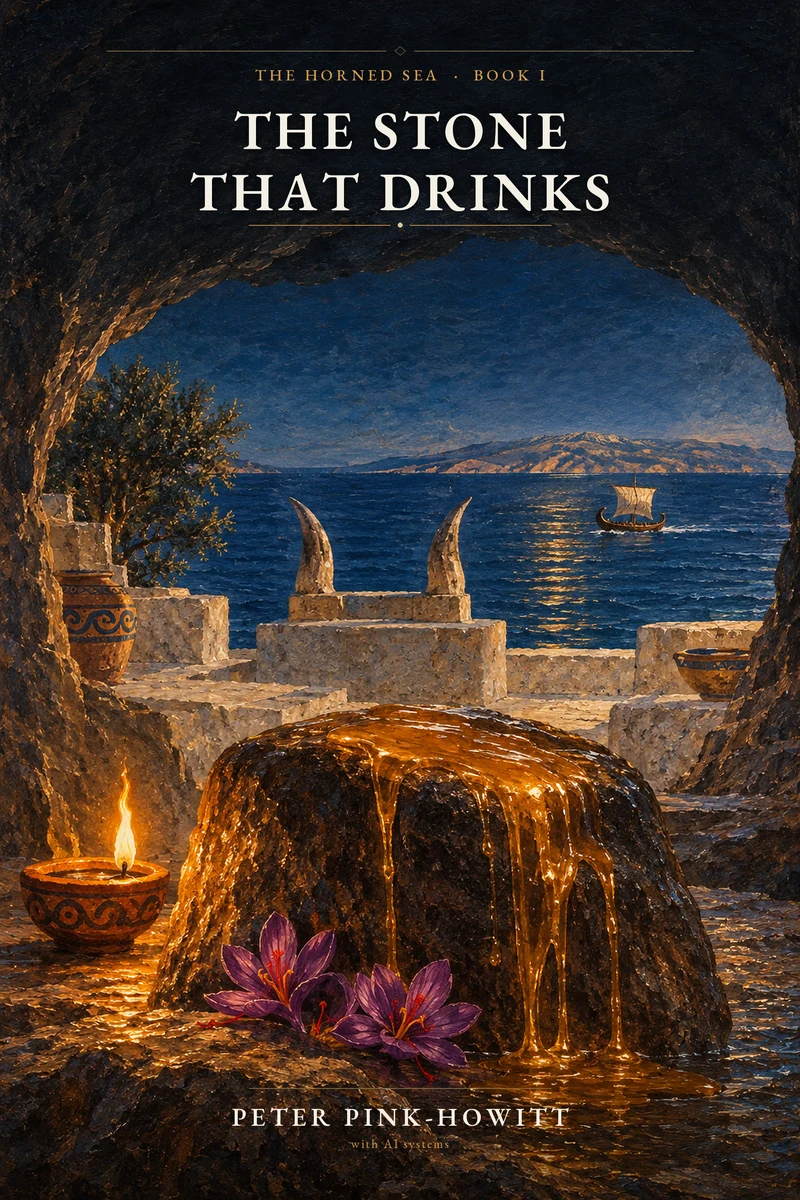
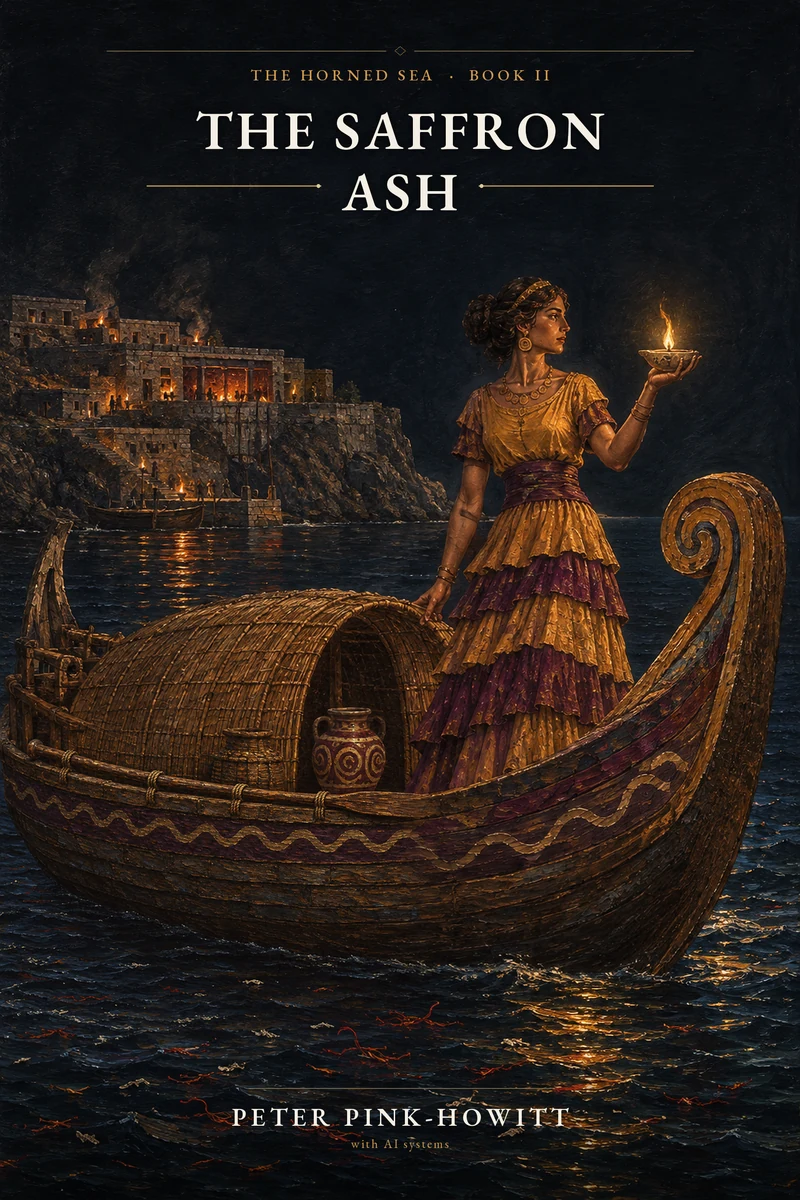
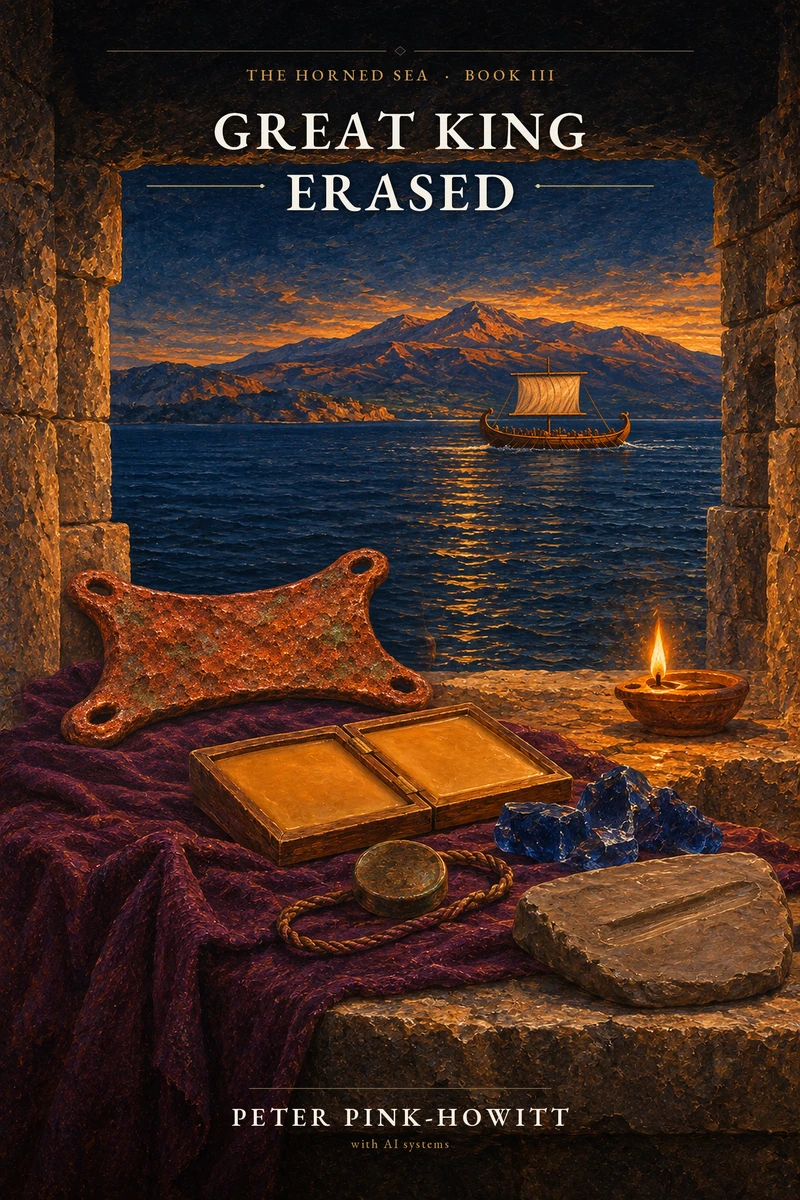
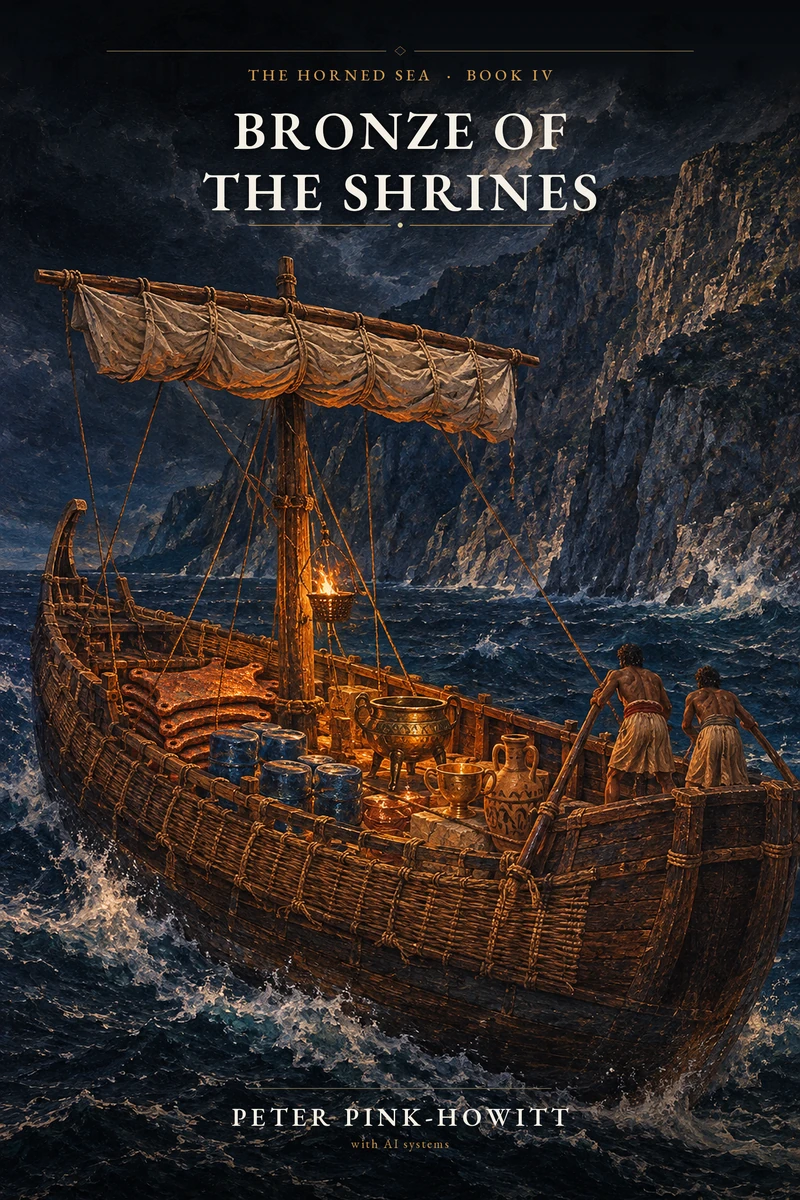
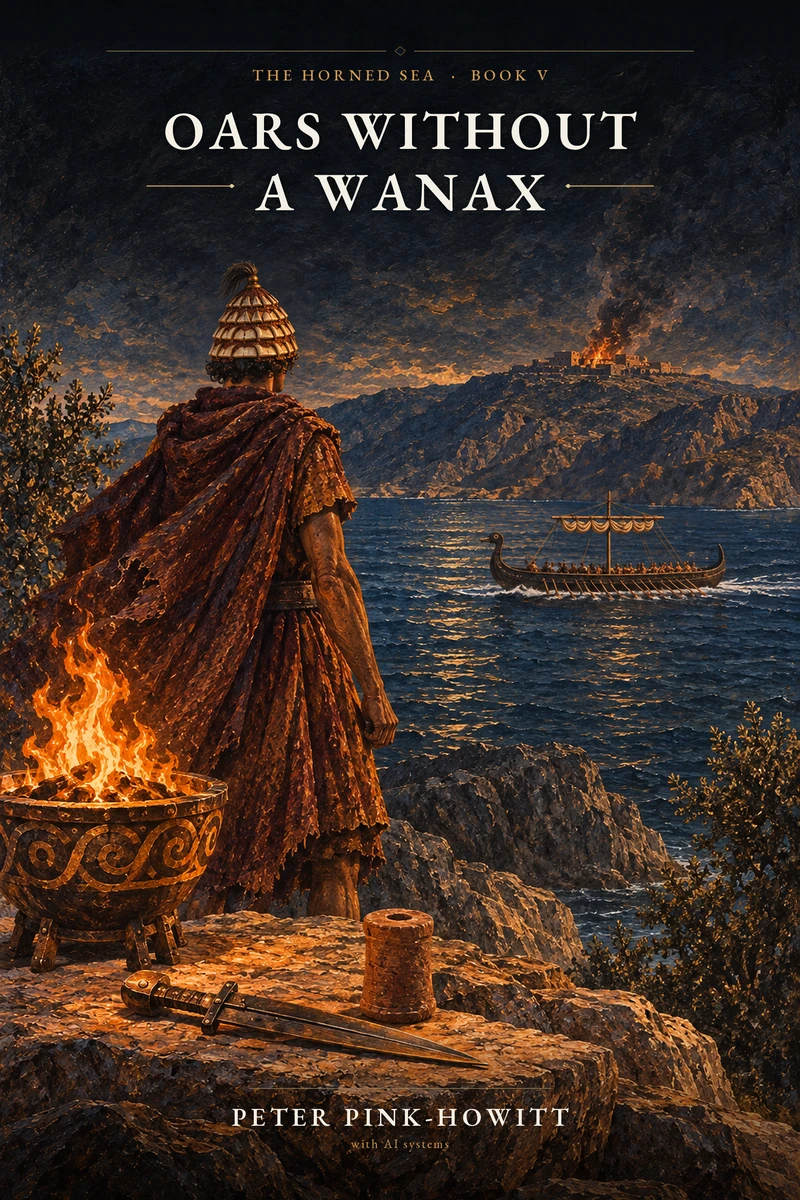
Book I Cover Proof — The Stone That DrinksBook II Cover Proof — The Saffron AshBook III Cover Proof — Great King ErasedBook IV Cover Proof — Bronze of the ShrinesBook V Cover Proof — Oars Without a Wanax
ONE PAINTING ACROSS FIVE SPINES
The Five-Book Spine Painting and the Five Covers
The continuous five-book spine painting (78.1 mm of shelf across 1,366 pages) follows one beaten-gold sea-wave across dark patinated bronze: honey-lit Cretan cave stone, saffron crocus, and sunlit blue sea (Book I: The Stone That Drinks, 302 pages) give way generations later to floating pumice and burning Cretan coastal houses (Book II: The Saffron Ash, 254 pages), break against the sea-wall of Millawanda (Book III: Great King Erased, 238 pages), catch the oil-smoke fire above Pylos (Book IV: Bronze of the Shrines, 254 pages), and open out onto starlit eastern water aboard a single fifty-oar hull (Book V: Oars Without a Wanax, 318 pages).
Select the spine sheet or cover proof to inspect the full-resolution WebP plate, or test flush shelf alignment on the home spine vitrine.
Painting Surfaces, Book I Cast, Cover Pair, Spine Painting & Scripts
Five studio sheets show brushwork texture and mineral pigments across three historical periods, introduce the four working focalisers of Book I, pair the two Cretan covers, set out the flush and parted five-book spine painting, and compare all four Bronze Age scripts.
PIGMENTS & PAINTING SURFACES
Six Visual Lanes, Brushwork Studies & Three Historical Surfaces
1800 × 1786 WebP · Pigments & Surface Studies
Sets out the mineral and oil-pigment palette across covers, workshop scenes, lamp-lit interiors, harbour panoramas, sea charts, and carved carnelian seal chapter openers on clean white ground.
BOOK I CAST · CRETE & THE ROUND ISLAND
Book I Character Portraits: Aresana, Kupanu, Midamara & Teyare
1800 × 1308 WebP · Four Portraits & Working Tools
Presents the four working focalisers of Book I (The Stone That Drinks) at work: Aresana painting blue reeds onto damp lime plaster, Kupanu gripping his grey volcanic dive-stone beside spiny murex shells, Midamara pouring amber honey onto Amnisos stalagmite stone under saucer lamps, and Teyare in cross-thonged Cretan mountain boots on Mount Ida scree.
FIVE-VOLUME COVER SHELF · BOOKS I TO V
Five-Volume Cover Suite & Shelf Study (Books I–V)
1800 × 1195 WebP · Five Covers & Shelf Study
Gathers all five painted covers — Amnisos honey-stone and Horns of Consecration (Book I), the torchlit Minoan crescent hull departing burning Cretan terraces (Book II), copper oxhide ingot, wax diptych, cobalt glass, and scraped clay tablet above Millawanda harbour (Book III), the storm-lit cargo hull rounding rocky cliffs (Book IV), and the boar-tusk-helmed watcher beside tripod fire, flanged sword, clay spool-weight, and fifty-oar bird-prow galley (Book V) — above dark and cream shelf rows.
Shows both the flush five-book shelf block and the parted spines across The Stone That Drinks (302 pages), The Saffron Ash (254 pages), Great King Erased (238 pages), Bronze of the Shrines (254 pages), and Oars Without a Wanax (318 pages).
FOUR BRONZE AGE SCRIPTS
Linear A, Linear B, Hieroglyphic Luwian & Hittite Cuneiform
1800 × 1227 WebP · Linear A, Linear B, Luwian & Cuneiform
Vector inscription plaques on warm rag paper across Minoan Linear A (PK Za 11 serpentine libation sequence and HT 13 wine fractions), Mycenaean Linear B (Knossos and Pylos PY Jn 829 bronze tallies), Anatolian Hieroglyphic Luwian biconvex seals (Mira and Wilusa), and Hittite diplomatic cuneiform (CTH 105 in Book III).
Portfolio Boards I–IV
Four museum-style plates set out the people, harbours, sanctuaries, palace interiors, vessels, hulls, and sea chart across Books I to V.
Pairs Cretan workshop craft with a sunlit southern harbour panorama and two contrasting Minoan sacred spaces: a wind-scoured mountain peak shrine and a lamp-lit subterranean gypsum basin.
People: Cretan workshop custodians weigh dried saffron stigmas against a 65 g lead disc beside a red carnelian agrimi-ibex wrist-seal and murex-stained fingertips.
Kommos Harbour: High-curved Cretan hulls round Kommos Reef toward the LM IB ship-shed hall at Kommos (Building T), keeping open turquoise water down the centre fold.
Sanctuaries: The stepped Petsophas shrine with Horns of Consecration and green serpentine PK Za 11 table above Cape Sidero, paired with a sunken selenite gypsum basin housing the ivory-and-gold Palaikastro Kouros.
BOARD II · CHARIOTS, SHIPS & PALACE HALLS
15th vs 12th Century Arms & Knossos vs Pylos Interiors
1800 × 1350 WebP
Traces the shift across Books II to V from palace-issued bronze chariotry and oil-filled magazines to twelfth-century sea crews and the circular hearth inside unfortified Pylos.
15th vs 12th Century Arms: Contrasts Book II’s hammered Dendra bronze corselet, boar-tusk helm, and four-spoked elm chariot (KN Sc 236) against Book V’s open-decked fifty-oar bird-prow galley (single upper yard, no lower boom) landing men with round shields and flanged Naue II swords.
Knossos vs Pylos Interiors: Contrasts Book II’s downward-tapering red cypress columns, corded olive-oil pithoi, and Room of the Chariot Tablets clay work with Book IV’s great circular hearth and griffin wall-painting in Hall 64 at Pylos.
BOARD III · VESSELS, INGOTS & SHIPS
Ceramic, Stone & Metal Objects + Two Bronze Age Hull Families
1800 × 1275 WebP
Gathers six standalone object studies on clean white ground above side-profile ship studies showing how Bronze Age rigging changes across the series.
Six Object Studies: Marine-Style octopus ewer, gilded black steatite bull’s-head rhyton, inscribed West-Cretan ka-ra-re-we transport stirrup jar, 29 kg Cypriot copper oxhide ingot, Uluburun raw ku-wa-no blue glass ingot, and twelfth-century fifty-oar bird-prow galley.
Two hull families: the high-curved Cretan hull of Books I–II, and the fifty-oar galley of Books III–V, which moves from boom-footed sail to brailed, boomless rig across the last two books.
BOARD IV · FRONTISPIECE CARTOGRAPHY
Sea Chart of the Aegean and Western Anatolia
1800 × 1088 WebP
Copperplate hachure and pale mineral-wash chart on warm rag ground mapping Bronze Age coastlines, including the open Latmian Gulf at Millawanda before river silt closed the bay.
Place-names as the tablets write them where they are attested (Ko-no-so, Pu-ro), and modern names in brackets where they are not.
Etesian Seamanship Scale: Sets a 100 km sailing-day bar against Crete’s 260 km spine — roughly a hundred kilometres downwind under the northern summer wind, versus thirty to forty-five kilometres hauled under oar.
Six Visual Themes Across the Five Novels
Every illustration belongs to one of six recurring subjects across Books I to V, tracking physical wear on inherited seals, tools, sanctuaries, and hulls.
THEME I · WORKING LIVES
People, Workshops & Inherited Craft
Follows working hands across all five novels: Book I’s four focalisers on the Round Island and Crete (Aresana, Kupanu, Midamara, Teyare), Book II’s saffron and murex workshops at Zakros and Knossos, Book III’s Millawanda dyers’ lane, Book IV’s Karpathia, the shrine’s key-bearer, with her curved bronze key at Pa-ki-ja-ne, and Book V’s salt-whitened oar-bench and loom households.
THEME II · SEA & LAND
Harbours, Coastlines & Sea Charts
Pairs the Aegean and Anatolian sea chart with wide harbour and mountain views across the Round Island and Kommos (Books I–II), the open Gulf of Latmos at Millawanda and the Karabel pass (Book III), and unfortified Pylos above Navarino Bay (Book IV).
THEME III · SACRED PLACES
Caves, Peak Shrines, Basins & Processions
Contrasts coastal stalagmite birth-caves, open Cretan peak shrines, sunken selenite gypsum basins, and sanctuary processions without a single Classical marble colonnade: Amnisos honey-anointed stalagmites (Book I), the Petsophas libation table and Palaikastro Kouros basin (Book II), Pylos’s Sailing-Month procession (Book IV), and the forge yards of Enkomi (Book V).
THEME IV · ARMS & OARS
Contests, Chariotry, Sea-Walls & Galleys
Moves from Book I’s single-glove Minoan boxing ring and bull-court to Book II’s hammered Dendra bronze chariotry (KN Sc 236), Book III’s Anatolian casemate walls, Book IV’s temple-bronze javelin levies (PY Jn 829), and Book V’s brailed bird-prow fifty-oar galleys.
Grounds daily life in wet-lime fresco scaffolds and volcanic-stone house courts (Book I), Knossos’s West Magazine storage jars and Room of the Chariot Tablets (Book II), Hattusa’s treaty chamber during the CTH 105 erasure (Book III), Hall 64’s great hearth at Pylos (Book IV), and the narrower post-palatial hall at Tiryns (Building T) in Book V.
THEME VI · WORKING OBJECTS
Seals, Weights, Vessels, Ingots & Early Iron
Carved chapter-opener objects and ship profiles across the five novels: Book I’s red carnelian agrimi-ibex seal, Mallia gold acrobat sword-pommel, and 65 g lead disc weight; Book II’s Zakros clay roundel and Marine-Style octopus ewer; Books III–IV’s reversible Luwian biconvex seal, Cypriot copper oxhide ingot, and Pa-ki-ja-ne bronze key; and Book V’s Enkomi iron ring-pommel knife and unbaked clay spool-loomweights.
Archaeometric Material & Palette Grammar
Grounded in Knossos and Akrotiri slaked lime plaster, Thera pumice, black-patinated bronze, haematite red, autumn saffron crocus, beaten gold, and Cycladic riebeckite and Egyptian blue — without Classical marble colonnades, Doric or Ionic capitals, Corinthian helmets, rammed triremes, or Attic red-figure borders.
Open Candidate Cover & Spine Exploration Note
Candidate cover studies, continuous spine mural boards, and edition wrap proofs are archived on this page as each volume locks.