Reading Room · Book II Dossier · Primary-Source Evidence Ledger
Book II: The Saffron Ash — Chapter 1: The Round Island Stone 16+
c. 1455–1435 BCE · 254 pages · Floor 16+ · Recommended 18+ · 4,668 words
Book II begins generations after Book I. Open the Chapter 1 preview
Read the opening chapter of Book II (4,668 words), set several generations after Book I in the eastern palace at Zakros.
Chapter 1: The Round Island Stone
The baskets came down off the saffron slopes in the last of the morning, eleven of them on the heads of eleven women, and Tukhana counted them through the court gate before she looked at what was in them, because a basket that is counted can be weighed and a basket that is weighed can be argued about, but a basket that has gone past the gate uncounted belongs to whoever is standing nearest the storeroom door. Eleven. She cut eleven strokes in the soft clay with the end of her stylus and set the leaf on the bench in the shade of the colonnade, where the sun off the court would not crack it before evening.
The crocus had come up on the slopes behind the town in the first rain after the fig-drying, the way it came up every year, all at once and all over the stony ground between the oaks, and the hill above Zakros went from grey to pale purple in three days. Under the colonnade the women sat on mats with the flowers heaped between their knees and pulled the three red threads out of each with a thumbnail, petals to one heap for the dyers, threads to a cloth, and by evening each cloth carried a red smear the size of a child’s hand, which, dried and weighed, was what Knossos wanted and the ships wanted and the slopes had been paid for in barley since their grandmothers’ grandmothers came to this coast.
Her own right thumb had a red crease in it that did not wash out. It had been there since she was Purwa’s age. It would be there when they carried her up to the house-tomb.
Purwa was on the third mat from the end, between Upara and a woman from the gorge houses, and her fingers were red to the second joint. She was fifteen. She had been picking threads since before the shearing and she was fast at it, faster than Upara, who had married at the spring feast and talked about her husband’s mother the whole of every morning and lost count of her own flowers. Tukhana watched her niece for the length of three flowers. The child pulled each thread and laid it, and did not drop any, and did not look up.
On the bench beside the leaf lay the roundel.
It had come in with the harbour tally three days before, a disc of clay the width of her palm, with a sign scratched on its face that meant copper and another beside it that meant the red threads, the two together, because the ship that had brought the copper had been promised saffron in return, and the roundel was the promise. Its face was inscribed and its rim was bare, and a bare rim is a promise nobody has yet put a name to.
She turned it over once with her finger and left it where it was.
The cousins from Ida had come in the night before, three of them, a man and his sister and the sister’s boy, with two mules and the year’s wool-cloth folded in packs on the mules’ backs. Twenty days off the mountain and along the coast road had ruined their feet and left their pride in the cloth untouched, and it was good cloth, the grey-white of the high folds, close-woven and heavy, bound east on the ships for copper, some of which would climb back to Ida in the spring as pins and a new cheese-pan. Her grandmother and theirs had arranged it between them, and it had held through two lords at Knossos and a bad earth-shaking.
The beam hung from its hook in the colonnade, a length of olive-wood polished black by hands, with a bronze pan on a cord at each end. Tukhana unwrapped the disc from its cloth.
It was grey and flat and a little bigger than the hollow of her palm, and the rim was worn smooth on one side where generations of thumbs had held it, and there was a nick in the face of it, near the edge, that her mother had said was made by her grandmother dropping it on a stone floor in a temper. It was lead. It had gone up from the river-mouth below Knossos to the folds on Ida in her grandmother’s grandmother’s time, and come down again to this coast with a bride, and it had weighed every bale that passed between the two halves of the family since. There were cut-stone weights in the storeroom with the court’s marks on them. The cousins would not have a court weight.
“My grandmother’s lead,” said the cousin’s sister, when she saw it, and touched it with one finger, which was what they always did.
“And hers,” said Tukhana.
She put the disc in the left pan and the first bale in the right, and the beam swung, and the bale went down and stayed down, which was right, because a bale is ten weights of the disc and the cousins had brought ten bales. So she weighed it the old way: the bale off, and its folded lengths one at a time into the right pan against the disc, a pebble on the step for each one that came level. Nine pebbles. The tenth length was the end of the bale, and the beam came up with it and hung level, or nearly, and she put her eye to the line of it against the edge of the colonnade pillar and watched it swing and stop and swing less and stop. It hung a hair low on the side of the lead, and the hair was the quarter-sign. She did the second bale’s tenth length, and the third’s. The same hair.
“Short,” she said.
The cousin’s brother had been watching the beam with his arms folded. He unfolded them. “It was weighed at the fold.”
“Against what?”
“Against the stone my father kept.”
“Then your father’s stone and my grandmother’s lead have been apart too long,” she said, “and one of them has been eating.” She took the length off and laid it on the others. “It will be short by a quarter of a weight on each bale, which is two and a half weights on the ten. I will book it so. Who stands for the two and a half?”
He did not like the question. She had not expected him to like it; she was not asking it to be liked. If the copper came back short, someone at the court would ask who had stood for the cloth, and if the leaf said nobody, the leaf would say her. The brother looked at his sister. The sister looked at the boy, who was looking at the girls on the mats.
“Our house stands,” the sister said at last. “The fold below the long ridge. Dadumine’s fold.”
“Then I will put Dadumine’s fold.”
She cut it into the leaf: the cloth sign, ten strokes, the quarter-sign hooked beside each, and the mark that the fold had always used, which was a ewe’s ear with two nicks in it. Once it was cut she did not think about the cloth any more. There was a fold with a name under it now, and any question the court had in the spring would go up the mountain to the ear, twenty days there and twenty back. The fold stood. She wrapped the disc in its cloth and put it in the fold of her skirt.
The man from the court came across the flagstones while she was still tying the knot.
Kidaro had been in Zakros twenty days waiting for the copper, standing in the shade every morning with his arms crossed and his hair tied back in the Knossos tail, watching the saffron come in. He owned no ship and no copper. He was a convoy man; when hulls went from the eastern harbours to Amnisos they went under his tally and in the company of his escorts, and paid him for it.
“Factor,” he said.
“Kidaro.”
“The copper is up from the harbour. It came up in the night. My men brought it.”
“I did not hear it come.”
“You were asleep.” He smiled. He had a pleasant face, broad and clean-shaven, with a white scar through one eyebrow. “The ingots are in the long room. The ship goes out again tomorrow with the cloth and the threads, if the threads are weighed. I would like to see the roundel sealed before it goes.”
“So would I,” said Tukhana.
She looked at the roundel on the bench, and so did he. Its rim was bare. Neither of them touched it.
“Eight were promised,” she said. “Eight oxhides, from the east. I would like to see eight in the long room before I put my stone on anything.”
“You will see them.” He uncrossed his arms. “First, so you don’t hear it from the harbour women. In the summer two small boats from the bay below the headland went to Karpathos for timber.” He held up two fingers and let them drop. “Eight men in each. Alone.”
“I heard about the boats.”
“One came ashore in pieces on the Karpathos side.” A saffron woman went past with a basket and he waited for her. “The Karpathos people say there were long ships on that water. Mainland ships, round the north of the island in the night.”
“That is a lone hull,” he said. “This harbour can’t guard itself. The bay can’t.”
“Knossos can.”
“Knossos pools the escorts at Amnisos and sends them out with the convoys, twenty hulls together with spears in them, and nothing comes round the north of anything.” He rubbed the scar in his eyebrow. “That costs.”
She knew all of it, and she knew that he had not yet said a word about the copper.
“How many are in the long room, Kidaro?”
He looked at the girls on the mats. “Go and see,” he said.
The long room ran off the west side of the court behind the magazines, narrow and windowless, with a plaster floor. She lit a lamp at the court brazier and walked it with the lamp held low, as she had walked it every day since her mother was carried up the hill.
The ingots lay on a mat at the far end, stacked crosswise, two and two and two. Six. Each was a flat slab cast like an ox-hide pegged out to dry, a leg at each corner for carrying, a talent or near it, the colour of old blood under the lamp and blistered on the upper face. She knelt and counted them with her hand on each, because lamp-light lies to the eye, and her hand found six.
Somebody had taken care over the stacking, so that a woman with a lamp would see a square stack and think it full. Under the bottom pair, where the mat was folded, there were marks in the plaster dust where two more had lain and been dragged off, the scrape of the legs going away towards the door.
She sat back on her heels.
The tally leaf from the harbour was in the niche where she had put it three days before, still damp at the heart under its wet cloth. The harbour scribe had cut what the captain said on the beach: the oxhide sign, eight strokes, the captain’s mark. The leaf said eight and the floor said six. She took her stylus out of her hair and made two strokes on the back where the clay was still soft, and beside them the sign the scribes used for what is owed and has not come, ki-ro, which every child in the magazines could say and which meant the hole where a thing should be.
Ki-ro, two.
Kidaro was waiting for her outside the door. He stood with the light of the court behind him and did not pretend he did not know what she had found.
“The escort is paid in copper,” he said. “Always. This year it is twenty hulls, not twelve.”
“Pay the eight with barley.”
“The barley is going to the villages.” He looked past her into the dark of the long room. “You know why.”
“Then the court can book it.”
“The court has booked it.”
“Where?”
“At Knossos.”
“Not on this leaf.” She held it up between them, wet side out. “This says eight came into my keeping. At the year’s end it will say six went out of it.” She lowered it. “In whose hand at Knossos?”
“In the hand of the escort.”
“The escort is twenty hulls,” she said. “Twenty hulls do not have a hand.”
He was a convoy man and had spent his life between harbours where nobody trusted anybody, and anger at a factor who did not trust him would have cost breath and changed nothing. He spent none.
“Put the court,” he said. “Put my name, if you like. It’s a good enough name.” Behind him one of his men laughed on the shrine steps and he did not turn. “Two ingots won’t feed anyone in this town. Two ingots put two more hulls between here and Karpathos.”
“Your name is not a house,” she said.
“No.”
“And the court is not a house either.”
“The court is all the houses.”
“Then all the houses can stand for it,” she said, “and when they come to me together, all of them, I will put them on the leaf. Until then I will put what is on the floor.”
He shrugged. It was a small shrug, almost friendly, the shrug of a man who has been told no by better factors than her and sailed anyway. “Then do what you have to,” he said, and went back across the court towards the shrine, where his men were sitting on the steps in the sun eating figs.
She went back to the bench and picked up the roundel and did not seal it.
In the afternoon she weighed the threads. She did it herself, with the pickers watching, because a woman who has picked since before dawn has a right to see her threads weighed by someone who will not lie about them. Each cloth-load dried on a bronze tray over the brazier until the red went dark and brittle and stopped smelling of flowers and started smelling of saffron, and then she tipped it into the pan against stone counterweights smaller than her thumbnail.
Purwa came and stood at her elbow while she did it. The child’s hands were red and her nails were red and there was a red smear across her cheek where she had wiped it.
“The man with the eyebrow,” Purwa said. “Upara says he took two of the copper.”
“Upara should pick her flowers.”
“She says the harbour women say it.”
“Then the harbour women should pick flowers too.” Tukhana set a stone weight on the pan. The beam steadied. “How many cloths did you pull?”
“Fourteen.”
“Fourteen is good.”
“Upara pulled eleven.” Purwa leaned closer and watched the beam. She had her mother’s chin and her mother’s habit of standing too close. “Will you put his name?”
“No.”
“Why not?”
“Because a name is not a house,” said Tukhana, and then, because the child was still standing there and still watching the beam, she said, “Hold this,” and gave her the cloth to hold under the pan so that no threads fell on the flagstones, which they would not have, but it gave the child something to do with her hands.
Evening came in from the west, over the gorge. At Zakros the sun drops behind the gorge cliffs long before it has gone down over the sea, so that the town lies in shadow while the far side of the bay is still bright, and the shadow crosses the court until the colonnade is dark and the women shake out their skirts and go home. The roundel lay on the bench with its rim bare.
They ate in the house, the four of them, Tukhana and Purwa and Tukhana’s mother’s sister, old and lame and mending nets nobody used, and the cousin’s sister from Ida, whose lodging in the harbour lanes was full of rowers. Barley with oil, the cousins’ cheese, figs, wine with water. The old woman always talked when there were guests.
She talked about the round island.
Tukhana had heard it so many times that she could have said it with her. The round-island houses had come across the sea in her grandmother’s grandmother’s time; the old woman was never certain of the count of grandmothers and did not think it mattered. The round island had a harbour and painted walls and a hill behind the town, and the hill began to shake, and the houses packed their boats and came away in the spring before anything worse happened, and the island burned behind them and went under the sea. Nobody had been hurt. The boats had come to the river-mouth below Knossos and the river-mouth people had made room for them, and the round-island houses had been given roofs and land and the use of the fishing water, and in time they had married into the river-mouth houses and the court houses and the folds on Ida, and here they all were.
The cousin’s sister listened with her chin in her hand. She had heard it too, up on Ida, in a different form.
“We say they came up the river,” she said, “and were given the high grass.”
“They were given everything,” said the old woman. “The round-island houses. They had been good to the river-mouth people when the river-mouth people came over in the old days, and so the river-mouth people were good to them. That is what my grandmother said.”
Tukhana said nothing. She had a different story, which she had got not from her grandmother but from a fisherwoman on the beach below the harbour, a hard old woman with a voice like a gull, who said that her people had come from the round island too and nobody had given them a roof. That they had slept on the shingle. That somebody had told them to wait for the spring, and they had waited, and the spring had come, and gone, and another, and they had built their own boats and gone east along the coast and found their own beaches. Tukhana did not know which was true. The round island was under the sea, everybody who had seen it was dead, and whatever her grandmother’s grandmother had cut on a leaf had gone into the pulping trough the spring after.
Purwa was not at the hearth.
She had been at the hearth when the barley came. She had eaten her barley and gone out to the yard to wash her bowl at the jar, and she had not come back, and the old woman was still talking about the round island and the cousin’s sister was still listening, and Tukhana sat with her own bowl in her lap and found that she was listening for the sound of the yard gate.
“Where is she?” she said.
The old woman stopped. “Who?”
“Purwa.”
“With Upara,” said the old woman. “Upara’s mother came for her. They are pulling the last of the threads in Upara’s mother’s house, the ones that came in late, and Upara’s mother said she would send her back before the lamps are out.”
“Upara’s mother came?”
“To the door. While you were washing.”
“Then it is Upara’s mother’s house,” said Tukhana, and she put down her bowl, and that was the end of it. She did not think about the child again until the lamps were low. Upara’s mother was a hard, sensible woman with three daughters and a son on the boats, and her house was four doors down the lane, and if anything happened to the child in that house it would be Upara’s mother who answered for it. There was a name on it. She could go to sleep with a name on it. The old woman went back to the round island, and Tukhana poured a little more wine and thought about the roundel.
She woke twice in the night. The first time she counted the ingots in her head, two and two and two, and the scrape-marks in the dust. The second time she thought about sixteen men from the bay below the headland and the long ships round the north of Karpathos in the night, and that Kidaro was very likely right, and that in his place she would have taken the two ingots too.
She was not Kidaro. Her name was on the leaf.
In the morning she went down to the harbour before the saffron women went up the slope, and found the harbour scribe, and asked him what the captain had said when the ship came in. The scribe was a soot-haired young man who was frightened of her. Eight on the deck under a cloth; he had counted thirty-two legs and divided by four, as he always did. The convoy man’s people had carried them up. Nobody from the town had gone with them.
She thanked him and went back up the hill.
It was not proof, and she did not need proof, because she was accusing nobody. A booking needs a count, and she had two: eight off the ship, six on the mat, and between them the convoy man’s people and the road.
The archive room lay behind the long room, through a low door, where the year’s leaves stood on end in straw until the spring pulping. Four cedar chests with bronze straps and bolts stood along the walls: the court’s, the harbour’s, the shrine’s, and the one that had been her mother’s and was now hers, for what the magazine kept in its own keeping.
She brought the roundel in and set it on the lid of her chest.
Then she took a lump of fresh clay from the jar in the corner, a lump about the size of a ripe fig, and worked it in her palms until it was soft, and wrapped it round the edge of the roundel so that the bare rim was covered with a band of new clay as thick as her finger. She smoothed the band with her thumb. She took her stylus and cut into the face of the roundel, below the copper sign and the saffron sign, a new mark: the oxhide, and two strokes, and ki-ro. Then she unhooked the carnelian from her wrist.
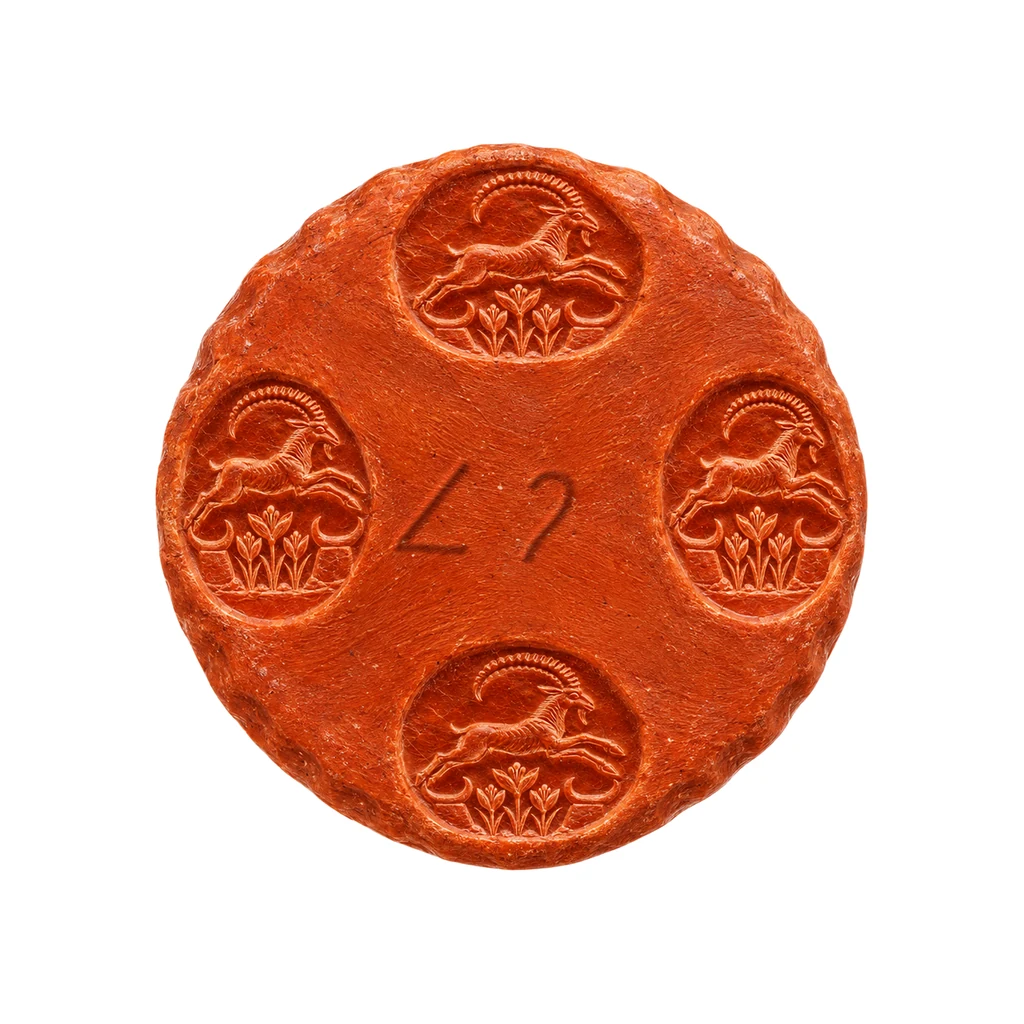
It was her grandmother’s seal. It had been on the wrist of every woman in her line since Samintha, who had brought it up to Ida with the lead. It was a small red stone, flattened and oval, the size of the end of her little finger, bored through for a cord, and on its face there was a wild goat cut leaping, its forelegs folded under its chest and its hind legs straight and its head flung back, with the horns curving over its spine almost to its tail. The cutting was old and the lines were worn soft at the edges. In the deepest of them, along the line of the goat’s back, there was a pale grain, a whitish grit that no washing had ever got out. Her mother had said it was ash from the round island. Her mother had said a good many things.
She pressed the stone into the band of clay at the top of the rim and rolled it a little to one side, so that the goat came up clear. Then she lifted it and moved it along the rim the width of the impression and pressed again. And again. She went round the rim of the roundel, the goat leaping after the goat leaping after the goat, each one pressed in hard, each one rolled so the horns came up sharp, until the band was full.
Ten.
Ten seals on a roundel meant that the house of the factor had witnessed this, and would witness it again at the end of the year, and would witness it at the pulping, and would not be argued out of it. It was what her mother had done twice in her life. It was what her grandmother had done once.
Purwa had come in behind her. She had come in barefoot and Tukhana had not heard her, and she was standing at her elbow again, too close, with her red fingers clasped in front of her.
“Let me do one,” Purwa said.
Tukhana did not look round. “There are ten.”
“Let me do the last one. I watched how you did it. You roll it to the left.”
“There are ten,” said Tukhana, “and the tenth is done.” She wiped the face of the stone on her skirt and hooked it back on her wrist and turned the cord so that the carnelian lay against the inside of her arm where nobody could see it. Then she took the roundel in both hands and laid it in the cedar chest on top of the straw, face up, so that the clay could dry in the dark without cracking.
“When will you let me?”
“When you are factor.”
“When will I be factor?”
“When they carry me up to the house-tomb,” said Tukhana, “and not before, and if you go on standing that close to me they will carry me up tomorrow, cooked.” Purwa stayed where she was. She was looking down into the chest at the roundel, at the ten goats round its rim, and her face had the look her mother’s used to have when she wanted a thing and had been told she could not have it, which was not a sulky look, but a careful one, as if she were measuring the distance between herself and the thing so that she would know it next time.
Then she put her hand on the chest.
She did not reach for the roundel. She laid her fingers flat along the cedar rim of the chest-side, where the lid would come down, as if she were steadying something that did not need steadying. Her nails were red. Her fingertips were red. The cuticles were red down to the half-moons. She had been pulling threads since before dawn.
Outside, a long way off, from the direction of the harbour, a conch blew.
It was the low long note that they blew at the east gate when a ship was sighted coming in, and it was answered by another from the harbour itself, higher and shorter, and then the first again. Tukhana stood up. She had the lid of the chest in her hand. It was heavy cedar, the width of her two arms spread, with a bronze strap across it and a bronze bolt that went down through a ring in the side, and she lowered it.
She lowered it slowly. She lowered it until the edge of the lid lay across the backs of Purwa’s fingers where they rested on the rim, and she stopped there, with the weight of it in her hands and the weight of it on the child’s fingers, not enough to hurt, enough to be felt. Purwa did not pull her hand away. She looked up. The conch blew again from the east gate, three long notes, which meant more than one ship.
“Take your hand away,” said Tukhana.
Purwa took her hand away. The lid came down. Tukhana put the bolt through the ring and turned it, and stood with her hand on the cedar, and listened to the conches going on and on along the harbour, counting the notes.